
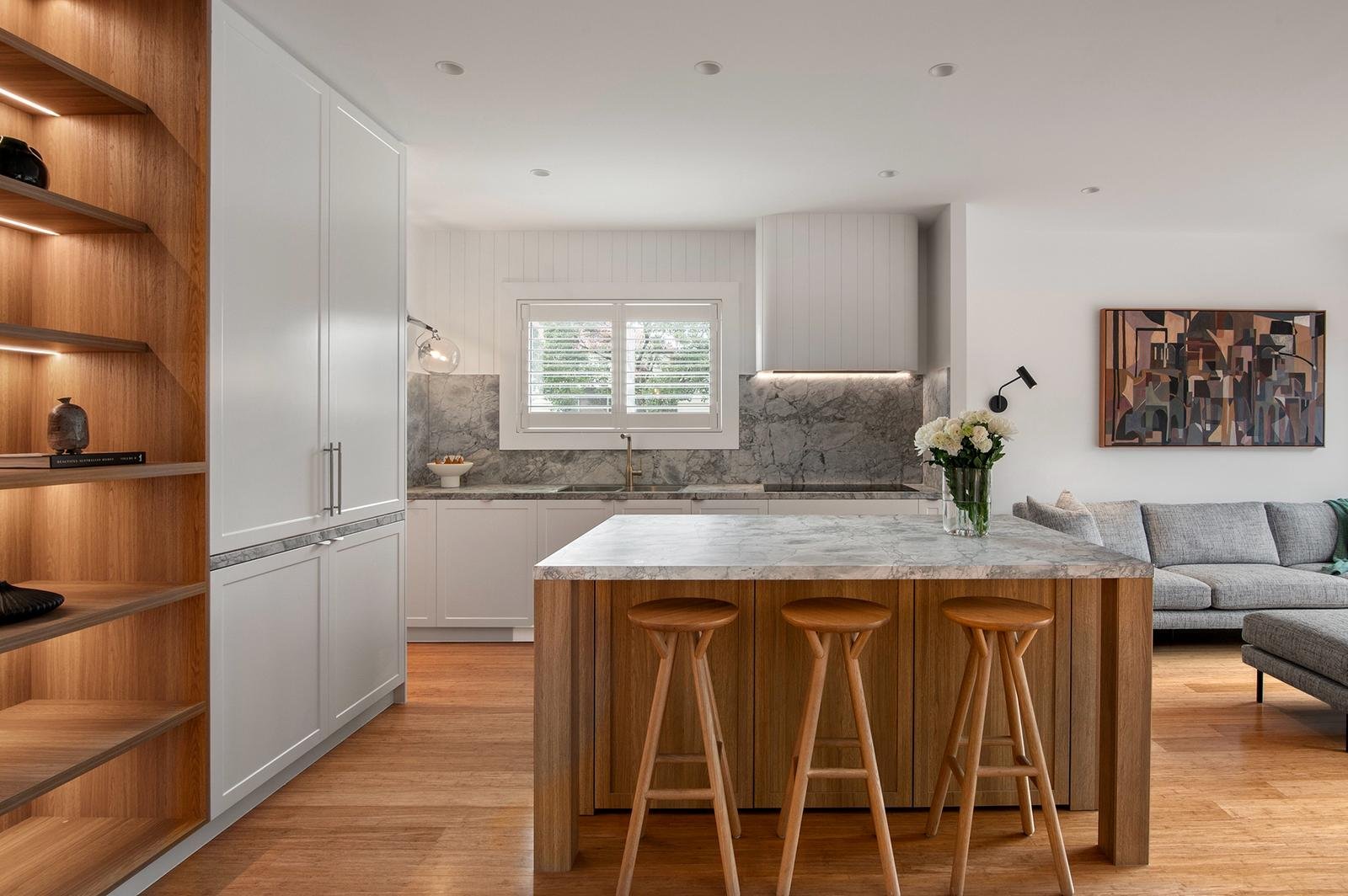
Just about every new Australian home has an open-plan kitchen — kitchen, dining and living all flowing together. It is the right call most of the time. The space feels bigger, kids can be supervised from the sink, entertaining is easier. But the layouts vary more than people realise, and the difference between a great open-plan kitchen and one that quietly annoys you every day is in the details.
Three layouts dominate Australian open-plan builds. Each has trade-offs.
The L-shape with island
Cabinetry against two adjoining walls in an L, with a freestanding island parallel to one of the legs. Most common layout in Australian project homes for good reason — works in spaces from 18m² up.
Why it works: Clear separation between cooking zone (the L) and serving/eating zone (the island). Two cooks can work without bumping. Island doubles as breakfast bar, kid homework spot, party drinks station.
Where it fails: When the island is too small. An island shorter than 1.8m feels mean. An island narrower than 900mm cannot fit a sink and bench space behind it. Builders often size the island to fit the room rather than what works for cooking — push back if you are getting an island under 2m × 1m.
The galley with peninsula
Two parallel runs of cabinetry, with one of them ending in a peninsula that creates a partial barrier between kitchen and living. Older Australian homes that have been opened up often end up here.
Why it works: Maximum bench space per square metre. Strong work triangle. Peninsula provides a soft visual divider without closing the room.
Where it fails: When the parallel runs are too close (under 1.1m apart, two people cannot pass) or too far (over 1.5m, you walk laps to cook). Sweet spot is 1.2-1.3m. Also, if the peninsula creates a single entry to the kitchen, that one entry becomes a chokepoint at dinner time.
The single-wall kitchen
All cabinetry on one wall. Often paired with an island that handles the prep work. Common in apartments and contemporary architect-designed homes.
Why it works: Sleek, minimalist look. Island handles social side. Suits homes where the kitchen is small relative to the open-plan space.
Where it fails: Storage is usually undersized — one wall just does not give you enough cabinetry for a family. Single-wall layouts work for couples or small households, generally do not work for families of four-plus.
The five details that make any open-plan layout actually work
Regardless of which layout you pick, these are the things that separate a great open-plan kitchen from a frustrating one:
1. Rangehood ducted to outside, not recirculating. Open-plan means cooking smells go straight into the lounge if the rangehood is just a fan. Recirculating filters do not work for fish or anything fried. Pay for ducted exhaust.
2. Acoustic treatment somewhere in the room. Open-plan = hard surfaces = echoing kitchen noise during dinner conversation. A rug under the dining table, soft furnishings in the living area, or acoustic ceiling panels make a huge difference.
3. Bin position you can access without bending awkwardly. Pull-out bins under-bench near the prep area. Not in the pantry, not on a side wall.
4. A landing area beside the cooktop and beside the sink. Each one needs at least 400mm of bench space adjacent. Cooktop with no landing means you cannot put down a hot pan. Sink with no landing means wet dishes pile up on top of each other.
5. The dishwasher position relative to the sink and the dish storage. Dishwasher next to the sink (so dirty dishes go straight in). Clean dish storage within an arm’s reach of the dishwasher (so unloading takes 60 seconds, not 5 minutes). Sounds obvious, gets ignored constantly.
None of those five are about style or budget. They are about how you actually use the kitchen every day. Get them right and any of the three layouts will work for your family.